

High security bollards in India are no longer a discretionary line item for facility managers. Global vehicle ramming attacks in 2025 and 2026 changed security planning. Government agencies, airports, and utilities now treat certified perimeter barriers as mandatory infrastructure.
| Key Takeaways Vehicle-as-a-weapon incidents in 2025 and 2026 accelerated HVM adoption. ASTM F2656 and PAS 68 now guide Indian critical infrastructure. BCAS and the Central Electricity Authority now mandate certified barriers. The rules cover airports and power installations. Crash ratings (M30, M50) define precise stopping thresholds; the legacy K-rating system stopped certifying new barriers in 2008. High-security bollard pricing in India is strictly quote-based through OEM channels, not published retail. |
Why Vehicle Ramming Threats Are Reshaping Perimeter Security in India
Vehicle-as-a-weapon (VAW) attacks have moved from rare incidents to a documented, recurring threat pattern. Vehicle ramming attacks increased during 2025 and 2026. They pushed ASTM F2656 and PAS 68 into critical infrastructure planning worldwide.
The implication for Indian facilities is direct. Traffic cones, speed bumps, and unrated bollards offer no meaningful resistance to a heavy vehicle at speed. A decorative steel post isn’t engineered to absorb kinetic energy. It deflects nothing that matters.
Regulators have responded. BCAS mandates certified physical barriers at sensitive Indian airports. These include bollards and road blockers. The Central Electricity Authority requires bollards and mantraps at power infrastructure. These protect operational technology and industrial control systems. The National Green Tribunal has also enforced bollard use for environmental demarcation, extending compliance requirements well beyond purely security-focused sites.
The result is a procurement environment where perimeter security bollards in India and vehicle security barriers in India are regulatory requirements, not optional upgrades. These developments highlight the importance of security bollards in India for protecting critical infrastructure.

Decoding Crash-Rating Standards: ASTM F2656, PAS 68, and What the Numbers Mean
Crash ratings exist to answer one question precisely: can this barrier stop a defined vehicle at a defined speed, and how far does the vehicle travel after impact?
ASTM F2656 M-Ratings Explained
The current international benchmark for perimeter security bollards is ASTM F2656. Its M-rating system defines stopping power by vehicle payload and impact speed. Under ASTM F2656-20, an M30 rating requires the barrier to stop a 15,000 lb (6,800 kg) vehicle travelling at 30 mph (48 km/h). An M50 rating raises that threshold: the same 15,000 lb vehicle must be arrested at 50 mph (80 km/h). These aren’t theoretical numbers. They come from physical crash tests.
The penetration (P) level is the second half of the specification. It records how far the vehicle’s payload travels past the barrier line after impact. For sites where even a few metres of vehicle travel could cause casualties, specifying the penetration class is as important as the M-rating itself.
The End of K-Ratings
Many older Indian procurement documents still reference K-ratings from the legacy U.S. Department of State system. That system officially stopped certifying new crash barriers in 2008. Modern specifications use ASTM F2656 M-ratings, which provide more accurate penetration metrics based on the vehicle’s payload rather than just the front bumper. An M30 broadly corresponds to the legacy K4 designation; M50 corresponds to K12. Referring to K-rated bollards in a 2026 tender is technically outdated.
Where PAS 68 and IWA 14-1 Fit
PAS 68 and IWA 14-1 are international equivalents that test barriers against similar impact scenarios. Many Indian government and defence tenders accept any of these three standards. Modern crash-rated bollards carry certification to one or more of ASTM F2656, PAS 68, and IWA 14-1, with the test certificate specifying the vehicle weight, speed, and resulting penetration distance.
| Rating (ASTM F2656) | Legacy K-Rating | Vehicle Weight | Impact Speed | Penetration Level |
|---|---|---|---|---|
| M30 | K4 | 15,000 lb (6,800 kg) | 30 mph (48 km/h) | Varies by test |
| M50 | K12 | 15,000 lb (6,800 kg) | 50 mph (80 km/h) | Varies by test |
Each tier raises the impact speed while holding vehicle weight constant. Specifying the wrong tier for a high-throughput entry point is a risk that no AMC contract can fix after the fact.
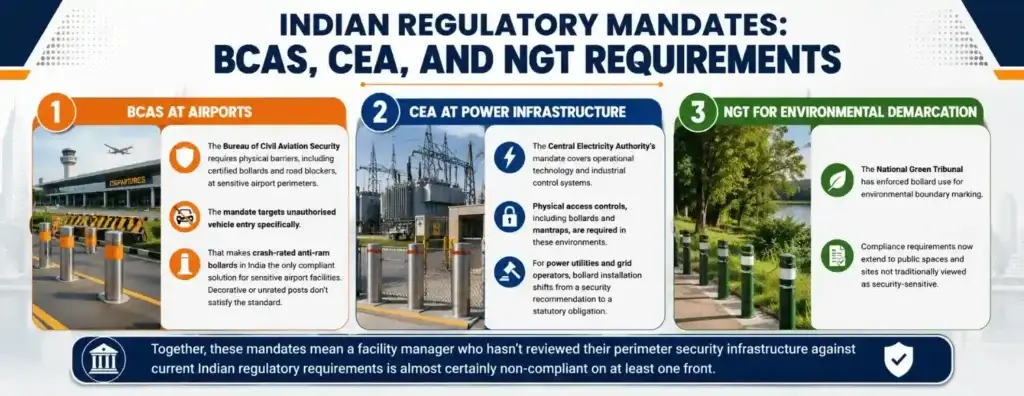
Indian Regulatory Mandates: BCAS, CEA, and NGT Requirements
Three Indian regulatory bodies now drive the majority of high-security bollard procurement at critical infrastructure sites.
1. BCAS at airports: The Bureau of Civil Aviation Security requires physical barriers, including certified bollards and road blockers, at sensitive airport perimeters. The mandate targets unauthorised vehicle entry specifically. That makes crash-rated anti-ram bollards in India the only compliant solution for sensitive airport facilities. Decorative or unrated posts don’t satisfy the standard.
2. CEA at power infrastructure: The Central Electricity Authority’s mandate covers operational technology and industrial control systems. Physical access controls, including bollards and mantraps, are required in these environments. For power utilities and grid operators, bollard installation shifts from a security recommendation to a statutory obligation.
3. NGT for environmental demarcation: The National Green Tribunal has enforced bollard use for environmental boundary marking. Compliance requirements now extend to public spaces and sites not traditionally viewed as security-sensitive.
Together, these mandates mean a facility manager who hasn’t reviewed their perimeter security infrastructure against current Indian regulatory requirements is almost certainly non-compliant on at least one front.
Fixed, Manual Bollards, and Automatic Hydraulic Bollards: Choosing the Right Type
Selecting the right bollard type is a site-specific decision. Threat level, operational tempo, and access requirements all feed into it.
Fixed crash-rated bollards suit permanent perimeter defence where vehicle access is never required at that point. They are commonly installed at airports, public spaces, and government facilities. Embedded in a concrete foundation, they provide continuous, passive resistance. Steel bollards in this category are common at government headquarters, defence installations, and data centres where no vehicle should ever cross the line.
Manual bollards, including removable models, suit sites needing occasional authorised vehicle access. A removable bollard lifts out for delivery access, then re-seats when that window closes. The trade-off is that the process requires a physical action and clear protocols, making it unsuitable for high-frequency access points.
Automatic hydraulic bollards handle dynamic access control: managing authorised traffic flow while maintaining a certified barrier against unauthorised vehicles. They connect with access control systems, RFID readers, and ANPR cameras to raise and lower on command. For airports, corporate parks, and government campuses where vehicle throughput is high, but security can’t slip, automatic bollards are the operationally practical answer. Retractable bollards in this category cycle rapidly without manual intervention.
The selection logic is fairly direct. A permanent threat boundary with no access requirement gets fixed bollards. Occasional access gets removable. Frequent authorised access with continuous threat management gets automatic hydraulic.
Specifying and Procuring Certified Bollards in India: What Buyers Need to Know
Procuring bollard systems in India doesn’t work like commodity purchasing. Pricing is strictly quote-based through OEM and B2B channels rather than published retail. That structure exists for good reason: a bollard specification involves site soil conditions, foundation depth, power supply routing for hydraulic units, integration with existing access control systems, and the crash-rating tier required by the applicable regulatory mandate. No published price list can account for those variables.
For Indian buyers, factory-direct procurement from a Made-in-India OEM/ODM removes several layers of supply-chain risk. HOM Automation operates three manufacturing units in Ghaziabad, Uttar Pradesh, producing hydraulic bollards and crash-rated barriers under one roof. Vertically integrated, in-house production means traceability from raw material to finished product. That matters when a procurement tender requires documentation of manufacturing origin and quality certification. The full product range covers the perimeter security and traffic management hardware that Indian B2B buyers typically specify together.
A practical specification checklist for any bollard project should cover: the crash-rating tier required (M30 or M50 under ASTM F2656, or the PAS 68 / IWA 14-1 equivalent), site soil conditions affecting foundation design, power supply availability for hydraulic units, and the integration protocol for the access control system already on site. AMC terms and a defined service life should be confirmed before contract award, not after. For sites where boom barriers and bollards need to work as a coordinated system, specifying both from a single manufacturer simplifies integration and accountability.
For project teams ready to define their perimeter security infrastructure, contact HOM Automation for a site-specific quotation and technical consultation.
Frequently Asked Questions
Can a crash-rated bollard be installed in sites with poor soil conditions or high water tables?
Soil conditions directly affect foundation depth and anchor design, so a geotechnical assessment is required before specifying any crash-rated bollard. Poor or waterlogged ground typically needs deeper pile foundations or a reinforced concrete raft, which changes both the installation timeline and overall project cost.
Do automatic hydraulic bollards require a dedicated power supply, and what happens during a power outage?
Hydraulic bollard systems need a dedicated electrical supply, and most units include a battery backup or manual override to maintain the barrier position during outages. The fail-safe default state, raised or lowered, should be specified at the design stage based on your site’s security priority.
Are perimeter security bollards in India subject to any additional cost considerations if sourced internationally?
Internationally sourced security hardware can introduce additional cost and lead time variables that affect project schedules. Sourcing from a Made-in-India OEM simplifies documentation for tenders that require proof of domestic manufacturing origin and removes cross-border supply chain risk.
How often do crash-rated bollards need maintenance, and who is responsible under an AMC?
Maintenance frequency varies by bollard type: fixed bollards need periodic inspection for corrosion and foundation integrity, while hydraulic units require regular fluid checks and mechanical servicing. An Annual Maintenance Contract should define the responsible party, response time, and service intervals before installation, not after commissioning.