

Boom barriers have become a key part of modern access control systems. They help facilities and traffic authorities manage traffic smoothly while maintaining security. These boom barrier gates help prevent unauthorised access and keep busy areas running smoothly. From corporate offices to toll plazas, boom barriers have become an essential part of traffic and facility management.
Today’s manufacturers are introducing systems that integrate easily with RFID cards, remote controls, and other access solutions. In this blog, we will explain how boom barriers function, explore the different types available, and help you understand which option suits specific environments and requirements.
“A secure barrier at the gate ensures safety for everyone inside.”
What Is a Boom Barrier?
A boom barrier, often called a boom gate, is a mechanical system that controls vehicle access. It consists of a horizontal arm that lifts or lowers to allow or prevent passage. When in the lowered position, the arm acts as a physical barrier, restricting vehicles from entering a facility. In the lifted position, it permits authorised vehicles to pass freely.
Modern boom barriers are often connected to access control systems, such as card readers or sensor-based systems. This setup helps vehicles move through faster with minimal waiting. When you select one of the best boom barrier manufacturers in India, they focus on creating systems that operate reliably, even in high-traffic locations.

What Are the 2 Main Types of Boom Barriers?
Boom barriers can be broadly categorised into two main types:
Automatic Boom Barriers
Automatic barriers use an electric motor to lift or lower the arm. They often connect with sensors, RFID readers, or remote controls, allowing vehicles to pass without human intervention. These barriers are ideal for locations with heavy traffic, such as toll plazas, airports, or large commercial complexes.
Manual Boom Barriers
Manual barriers require an operator to raise or lower the arm. They are typically used in areas with lower traffic or where the electricity supply is limited. While simpler and more cost-effective, manual barriers do not offer the same efficiency as automatic systems.
Automatic vs Manual Boom Barriers
| Feature | Automatic Boom Barrier | Manual Boom Barrier |
| Operation Speed | Fast | Slow |
| Traffic Handling | High | Moderate |
| Integration with Systems | Full | Limited |
| Maintenance Requirements | Low | Medium |
| User Convenience | High | Low |
What Are the Other Types of Boom Barrier Systems?
- Electromechanical Barrier: These barriers are widely used in offices, schools, and gated communities. They combine a simple mechanical arm with an electric motor to deliver smooth operation. These systems are easy to maintain & offer consistent performance, making them suitable for moderate traffic areas where efficiency and control are required.
- Hydraulic Boom Barrier: These barriers are ideal for toll plazas and industrial entrances that demand high-speed operation. They use hydraulic systems to quickly lift and lower the arm, even under heavy loads. Their robust design ensures long-term durability and the ability to handle continuous traffic without compromising safety.
- RFID-Integrated Barrier: These barriers are increasingly used in residential and commercial complexes. These systems allow vehicles to pass through without stopping, as access is granted automatically via RFID tags. This contactless operation reduces congestion and improves the overall efficiency of vehicle entry and exit.
- Crash-Rated Barriers: These barriers are designed for high-security environments such as government buildings and defence facilities. They provide enhanced protection against forced entry, including anti-ram resistance. These barriers combine strength and durability to ensure maximum security without compromising functionality.
- DC Boom Barriers: DC boom barriers provide accurate, consistent vehicle access control in demanding environments. The system features a zinc-coated CRCA steel body and an aluminium boom arm supported for stability. A permanent-magnet brushed DC motor ensures smooth operation, low power consumption, and dependable performance over time.
- Fencing Boom Barriers: These barriers are designed to manage vehicle access by adding physical restrictions. These systems use a sturdy zinc-coated CRCA steel cabinet paired with an aluminium boom arm that includes a hanging fence structure. This design helps prevent unauthorised crossing beneath the arm while maintaining a compact footprint.
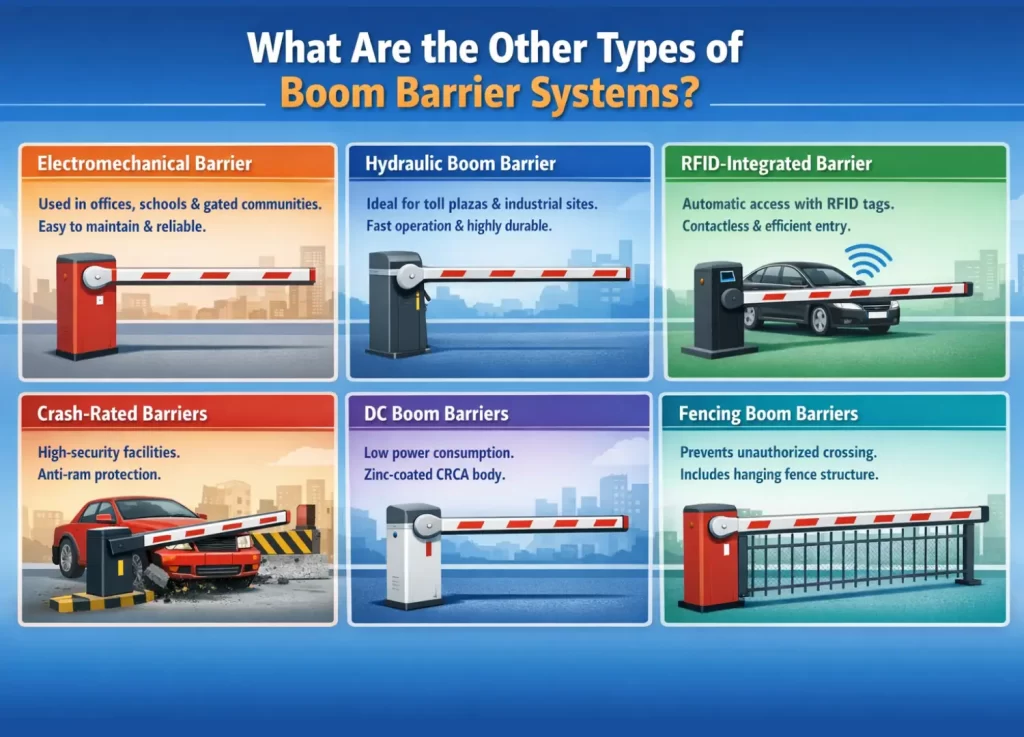
Comparison of Other Types of Boom Barrier Systems
| Type of Boom Barrier System | Ideal Environments | Major Advantages |
| Electromechanical Barrier | Offices, schools, gated communities | Reliable, efficient, easy to operate |
| Hydraulic Boom Barrier | Toll plazas, industrial entrances | High-speed operation, handles heavy loads |
| RFID-Integrated Barrier | Residential and commercial complexes | Enables contactless entry and reduces queuing |
| Crash-Rated Barrier | Government buildings, defence facilities | Provides maximum security with anti-ram protection |
| DC Boom Barriers | Commercial complexes, toll lanes, high-security zones | Energy-efficient, smooth operation, precise control, long lifespan |
| Fencing Boom Barriers | Industrial sites, restricted zones, high-security perimeters | Prevents unauthorised passage and provides a space-efficient design |
What Are the Advantages of Installing a Boom Barrier?
Installing a boom barrier comes with a few clear advantages:
- Improved Security: These systems prevent unauthorised vehicles from entering. Safety sensors reduce the risk of accidents.
- Efficient Traffic Movement: Vehicles pass smoothly, helping avoid congestion during busy hours.
- Reduced Staffing Costs: Automation lowers the need for constant supervision.
- Data and Monitoring: Entry and exit logs provide useful information for audits and traffic management.
Final Thoughts on Boom Barrier Types
Overall, boom barriers are a simple yet effective way to control vehicle access. They help facilities maintain order, improve safety, and reduce congestion. With guidance from experienced boom barrier manufacturers, sites can implement systems that are both reliable and efficient.
At Hom Automation Pvt Ltd., we focus on delivering solutions that simplify vehicle movement at entry and exit points. Our boom barrier systems are built to perform reliably in demanding environments, including areas with constant traffic and outdoor exposure. Contact us today to find the right boom barrier for your facility.
Frequently Asked Questions
How Long Can a Boom Barrier System Last?
A boom barrier system is built for long-term use and can generally function efficiently for several years. In most cases, a well-installed system lasts between 7 and 12 years, depending on usage and maintenance.
Are Boom Barrier Systems Weather-Resistant?
Yes. Boom barrier systems used for outdoor installations are built to handle varying weather conditions.
What Factors Influence the Performance of Boom Barrier Systems?
The efficiency of a boom barrier system depends on several key factors. High traffic volume can increase wear and tear over time. The length & weight of the boom arm influence how smoothly it operates. Additionally, motor capacity plays an important role in handling frequent cycles.