

Flap barrier system in India have shifted from optional upgrades to baseline requirements across corporate parks, metro stations, and government facilities. Security budgets continue growing across India. Procurement teams need clear information on system costs and vendor credentials. Smart access control India solutions now help organisations strengthen security while improving operational efficiency.
| Key Takeaways As of mid 2026, India’s access control market was valued at USD 661.8 million in 2025 and is projected to reach USD 1,809.8 million by 2033, at a CAGR of 13.51%. As of July 2026, flap barrier prices in India range from approximately ₹45,000 for entry-level models to over ₹6,00,000 for metro-grade installations. HOM Automation, established in 1993, manufactures flap barriers entirely in-house across three facilities in Ghaziabad, backed by a 15-year service life and AMC. |
Why Flap Barriers Are Now Standard in Indian Corporate and Public Infrastructure
Modern security solutions reduce manual intervention while improving monitoring and access control. Facility managers increasingly replace manual checkpoints with automated pedestrian access control. These systems log movement and support HR, entry management, and visitor management platforms.
Smart cities initiatives and rising institutional security budgets continue driving nationwide flap barrier adoption. India’s access control market reached USD 661.8 million in 2025. It could reach USD 1,809.8 million by 2033. That’s not incremental growth; it reflects a structural change in how Indian infrastructure is being designed. This growth reflects ongoing infrastructure development across India’s public and private sectors.
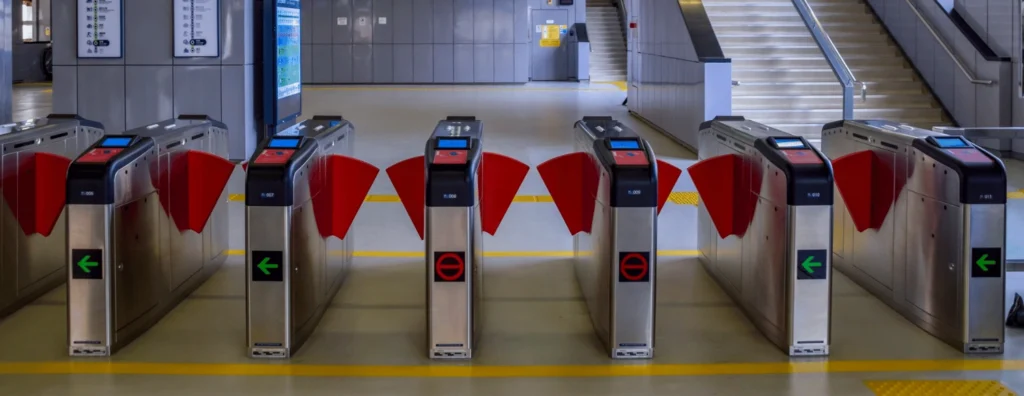
Flap barriers are a specific category of turnstile gates India-wide: low-profile cabinets with retractable wing panels that allow controlled, single-person passage. They’re a preferred choice for corporate lobbies, data centres, and high-security zones where aesthetics and throughput both matter.
How Flap Barrier Systems Work and What They Integrate With
The core mechanism centres on retractable wing panels housed inside a stainless-steel cabinet. On a valid credential read, the wings retract, letting one person through. Anti-tailgating sensors monitor the passage zone and can trigger an alert if a second person attempts entry without a separate credential. Bi-directional flow control means the same lane handles both entry and exit.
What makes modern flap barriers genuinely useful for integrated security is the access control layer sitting above the mechanical hardware. Systems support biometric access, RFID card readers, QR codes, and facial recognition.
Passage width is a practical specification that buyers often overlook at the tender stage. Standard commercial lanes run 500 mm to 600 mm. Wide-lane configurations extend up to 900 mm to accommodate wheelchairs. Specifying the wrong width at procurement creates costly retrofits later.
Flap Barrier Gate Price in India: What Drives the Cost
Pricing for a flap barrier gate in India, as of July 2026, spans a wide range depending on application tier, cabinet specification, and integrated reader type.
| Application Tier | Indicative Price per Lane | Typical Use Case | Common Integration |
|---|---|---|---|
| Entry-level | From ₹45,000 | SME offices, corporate offices, residential complexes | RFID card reader |
| Mid-range | Varies | Corporate campuses, universities, data centres | Biometric + RFID |
| Metro/High-security | Over ₹6,00,000 | Metro stations, PSU headquarters, airports | Facial recognition + biometric + QR |
The gap between entry-level and metro-grade pricing reflects several real cost drivers. Cabinet material is one consideration: stainless steel construction, such as SS 304, suits environments where corrosion resistance matters. Lane width adds cost, particularly for wide-lane accessible configurations. The integrated reader type, whether a basic RFID module or a multi-modal biometric and facial recognition unit, is often the single largest variable.
Procurement route also affects total cost in ways that don’t always appear in the initial quote. Buying direct from a domestic OEM typically means factory-direct pricing, local AMC coverage, and a direct line for spare parts. Routing through a third-party system integrator adds margin but can add value through project management and multi-vendor integration. Importing foreign systems introduces currency risk, longer lead times, and support gaps that get expensive fast when a lane goes down at a busy facility. For automatic entry gates India-wide, domestic OEM supply chains have a clear logistical advantage.
15-Year Service Life, AMC, and What Long-Term Support Actually Means for Buyers
Unit price is the wrong metric for evaluating security gates for buildings in India. Total cost of ownership over a five-to-ten-year horizon is what actually determines value, and that calculation has to include maintenance, spare parts availability, and downtime risk.
HOM Automation backs its flap barrier systems with a 15-year product service life, supported by Annual Maintenance Contracts and a lifetime support commitment. For a facility manager running a multi-lane installation at a corporate campus or a government headquarters, this means predictable maintenance budgets and a clear escalation path when something needs attention. At a busy entry point, even a single lane going offline during peak hours creates a security gap and a queue problem at the same time. Reliable systems maintain smooth traffic flow during peak entry and exit periods.
Beyond Pedestrians: High-Security Perimeter Defence
Pedestrian access control and vehicle perimeter defence are distinct problems, and buyers specifying a complete site security solution need to understand where flap barriers end and crash-rated barriers begin.
HOM’s heavy-duty anti-ram products, including bollards and road blockers, are simulation-assessed to international crash-test standards: ISO IWA 14-2:2013, BSI PAS 68:2013, and ASTM F2656 for K4-equivalent impact performance. These aren’t the same category as a flap barrier gate, but they come from the same in-house manufacturing capability.
For integrators scoping a full perimeter solution, having both pedestrian and vehicle barrier products from a single certified domestic OEM simplifies vendor management considerably.
The Bottom Line for System Integrators and Security Consultants
The India access control market’s 13.51% CAGR growth trajectory means procurement decisions made today lock in vendor relationships for a decade or more. Choosing a domestic OEM with GeM compliance, proven institutional deployments, and in-house manufacturing isn’t a conservative choice; it reduces supply chain and support risk over the life of the installation.
When evaluating any flap barrier system India vendor, ask for ISO certifications, reference deployments at comparable facilities, AMC terms in writing, and lane configuration flexibility across passage widths. For integrators and consultants ready to scope a project, contact HOM Automation directly for a B2B quote tailored to your site requirements.
Frequently Asked Questions
Can flap barriers handle outdoor installations in Indian weather conditions?
SS 304 stainless steel cabinets are used in flap barrier construction and suit environments where corrosion resistance is a concern. For any outdoor or exposed installation, confirm ingress protection ratings with your OEM before finalising the site layout.
Do flap barrier systems in India require any specific electrical infrastructure?
This varies by model and integration tier, so confirm exact requirements during site assessment. Generally, multi-lane installations with biometric readers and facial recognition have different power demands than basic RFID-only setups, and power continuity provisions are worth planning for at high-footfall facilities.
What passage widths are available for flap barriers in India?
Standard commercial lanes typically run 500 mm to 600 mm. Wide-lane configurations are available up to 900 mm to accommodate wheelchairs and users with mobility aids. Confirm the right width for your site during the specification stage, since retrofitting the wrong lane width after installation adds cost.
Is white-labelling available for system integrators who want to resell flap barriers under their own brand?
Yes, HOM Automation offers OEM and white-labelling capabilities, as demonstrated at IFSEC India 2024. Integrators evaluating a manufacturing partner for private-label supply should request commercial terms directly, since pricing and minimum order conditions vary by project scope.