

Choosing the best turnstile gate India 2026 means more than picking a price point. Indian factories are now evaluating gate type, throughput, compliance standards, and integration readiness before a single unit ships. This guide covers everything procurement teams and security consultants need to make that call.
| Key Takeaways 1. Global demand for turnstiles is growing as industries and governments strengthen access control and perimeter security systems. 2. Indian factories can choose from manual tripod turnstiles, automatic models, flap barriers, and full-height turnstiles. Each suited to different risk levels. 3. Manual tripod turnstiles are generally the most economical option. Meanwhile, automatic models command higher prices because of motorised operation and integration capabilities. 4. Factory buyers should ensure turnstile installations comply with applicable National Building Code (NBC) provisions and relevant Indian Standards before project execution. |
Why Indian Factories Are Upgrading to Automated Turnstile Gates in 2026
Manual security checkpoints are giving way to automated entry-exit systems across Indian manufacturing facilities. Smart Cities Mission and Digital India are accelerating industrial automation. They also increase demand for modern factory access systems. Demand for factory access control gates is increasing as manufacturers strengthen workforce and visitor security.
The market numbers reflect this. Global demand for turnstiles continues growing as industries invest in modern access control and perimeter security. Industrial expansion and stronger perimeter security are driving India’s growing demand for modern turnstile access systems.
Types of Turnstile Gates Used in Industrial and Factory Settings
Selecting the right turnstile starts by understanding each gate type and its practical industrial application. The types of turnstile gates available in India span a wide range of security levels and throughput capacities.
Full-height turnstiles suit industrial sites requiring strong pedestrian access control and enhanced perimeter security. For facilities looking for a high security turnstile India solution, full-height models remain the preferred choice because of their superior perimeter protection. There’s no ambiguity at the boundary.
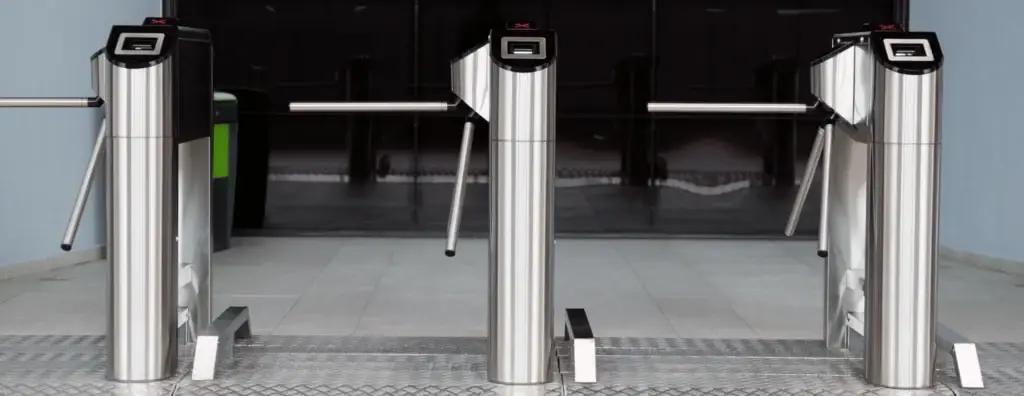
Tripod turnstiles are the workhorse for high-throughput employee access. They integrate with biometric readers, RFID cards, and QR scanners for smooth shift changes at mid-sized factories. Understanding how a tripod turnstile gate works helps buyers match the mechanism to their footfall pattern.
Half-height turnstiles suit factories needing controlled access without installing a full-height barrier. It balances security with high throughput in medium-risk areas.
Flap barriers and speed gates suit office-adjacent factory zones where throughput speed and a professional aesthetic both matter. Flap barrier access control systems enable fast movement and are commonly used in factory offices and corporate lobbies.
Many factories install swing gates to improve accessibility for wheelchair users, visitors, and emergency situations.
Matching gate type to site risk, footfall volume, and physical layout is the correct starting point. A high-security perimeter and a visitor lobby don’t share the same answer. Before comparing prices, buyers should evaluate important turnstile features such as throughput capacity, access control compatibility, durability, and integration options.
Turnstile Gate Prices in India: What Factories Should Budget
As of February 2026, the turnstile gate price in India ranges considerably by type and automation level. Manual tripod turnstiles sit between ₹25,000 and ₹45,000. Automatic tripod models run from ₹90,000 to ₹1.6 lakh. Full-height turnstiles and flap barriers are typically quote-based, with pricing driven by integration complexity, site count, and reader hardware.
| Type | Price Range (INR) | Avg. Throughput | Best For |
|---|---|---|---|
| Manual Tripod Turnstile | ₹25,000 – ₹45,000 | Moderate | Small factories, budget-constrained sites |
| Automatic Tripod Turnstile | ₹90,000 – ₹1.6 lakh | Approximately 20 persons/min | Mid-to-large factory employee access |
| Full-Height Turnstile | Quote-based | Varies by model | High-security perimeters, restricted zones |
These are unit costs only. Total cost of ownership for a factory deployment also includes civil installation, maintenance through an Annual Maintenance Contract (AMC), software API licensing, and reader hardware. Buyers procuring across multiple gates should factor AMC into the five-year budget from day one, not as an afterthought.
Indian Compliance Standards Every Factory Buyer Must Know
Compliance isn’t optional. Indian access control installations are required to meet the National Building Code (NBC) 2016 and Bureau of Indian Standards (BIS) IS 1890:Part 1 for safety, emergency egress, and accessibility, as confirmed by BIS and industry sources as of July 2026. Non-compliance creates liability and can delay project sign-off with local authorities, particularly on government and PSU sites.
BIS IS 1890:Part 1 and NBC 2016 mandate specific accessibility and safety provisions for access control doors and turnstiles in Indian buildings. Procurement teams should confirm the exact requirements with a compliance consultant before finalising gate layout, since the provisions cover both safety and accessibility considerations.
For factory perimeters where vehicle intrusion is a threat, crash-rated barriers enter the picture. HOM Automation’s crash-rated barriers and bollards are simulation-assessed to ISO IWA 14-2:2013, BSI PAS 68:2013, and ASTM F2656 for K4-equivalent impact performance. These aren’t marketing ratings. They’re internationally recognised standards that procurement officers on defence and government projects will ask for by name. Buyers should request crash-test certificates and route technical specifications to datasheets before signing off.
Integrating Turnstiles with Biometric, RFID, and Facial Recognition Systems
A turnstile gate on its own is a physical barrier. Connected to the right authentication layer, it becomes a full entry-exit system. Tripod and full-height turnstiles in India are routinely integrated with biometric access readers, RFID access cards, facial recognition units, and QR scanners to create fully automated pedestrian access control.
The practical benefit for factories is dual: security and administration. Integrated employee attendance data feeds directly into payroll, shift tracking, and visitor management workflows, removing manual registers entirely. CCTV integration adds another layer, linking gate events to camera timestamps for audit purposes.
Before specifying any integration, procurement teams should confirm three things: the communication protocol the turnstile supports, the power supply requirements at each gate point, and whether the chosen access control software has a compatible API. These details decide whether installation runs smoothly or turns into a costly retrofit.
Buying Direct from an Indian OEM: What It Means for Factory Projects
Factory-direct procurement from turnstile gate manufacturers in India cuts out distributor margins, shortens lead times, and opens the door to custom configurations that off-the-shelf imports can’t match. That certification matters for large multi-gate deployments: it signals consistent product quality across every unit in a batch, not just the sample.
For system integrators and resellers, OEM/ODM white-labelling is a practical option. Structured AMC terms reduce the total cost of ownership significantly compared to imported units with limited local support. When something needs attention on a PAN-India rollout, local manufacturing support is not a minor convenience. It’s a project-critical factor.
The HOM Automation product range delivers complete turnstile gate solutions for factories, covering perimeter security solutions and access control hardware backed by in-house manufacturing expertise built over decades of Made-in-India production.
Frequently Asked Questions
How long does a typical factory turnstile installation take from order to commissioning?
Installation timelines vary by site complexity, gate count, and civil readiness, so there’s no single figure. Multi-gate factory deployments generally require civil groundwork to be completed before equipment arrives. Buyers should confirm lead times directly with their chosen manufacturer during the quotation stage.
Can turnstile gates handle India’s outdoor conditions, including monsoon humidity and dust?
Turnstiles deployed at outdoor factory perimeters need enclosures rated for the environmental conditions at the site. Buyers should request the relevant environmental protection specifications for any unit intended for outdoor use. Make sure to confirm suitability against site conditions before finalising the specification.
Are there accessibility requirements for workers with disabilities at factory turnstile checkpoints?
Yes. BIS IS 1890:Part 1 and NBC 2016 mandate specific accessibility and safety provisions for access control doors and turnstiles in Indian buildings. Procurement teams should confirm the exact requirements with a compliance consultant before finalising gate layout.
What happens to a turnstile gate during a power failure or fire alarm at a factory?
Emergency egress requirements under NBC 2016 mean power failure and fire alarm scenarios must be considered during the design stage. Buyers should discuss egress and power continuity requirements with their chosen manufacturer and a compliance consultant before finalising the installation specification.